
Home / War on bookies / Stories
Your bet can lose by a point that was never scored.
On 14 November 2026 Galatasaray lost a Turkish league game 82-81 to Körfez on a basket in the last second. Nine days later Galatasaray said in a public statement that one of Körfez's 82 points was never scored on the court. It was only written down. If they're right, that game should have gone to overtime. And every bet on it was settled on a point that never happened. This is about that point, and about all the other ways a bet can lose that have nothing to do with how good your bet was.
The short version
- A one-point game, and one point nobody scored. Third quarter, 7:33 left: a Körfez dunk went into the official play-by-play as a three. The TV board showed 55. Two minutes later, mid-possession, it jumped by one to match the sheet. The point
- Nobody saw it during the game. Not the bench, not the refs, not the TV. The federation hasn't ordered a replay. Nobody saw it
- Your bet is settled on the official result, not the truth. Even if the game were replayed tomorrow, the bets on it are already settled. Your bet
- Being right isn't enough. The table, the stats, the ref, the last second, a fixed game, the bookie itself: each one can lose you a bet you got right. All the ways a bet can lose
The point nobody scored
Turkish Basketball Super League, week 8. Biotekno Körfez Basket at home against Galatasaray MCT Technic. Körfez led by 10 going into the last quarter. Galatasaray won that quarter 21-12, went ahead late, and then lost it on a Körfez basket in the last second. Final score 82-81.
On 23 November Galatasaray published a statement. Its title says a point that wasn't won on the court can't be turned into a win at the table. They say their club went through the official scoresheet, the play-by-play and the broadcast, and found a point written to Körfez that was never scored on the court.
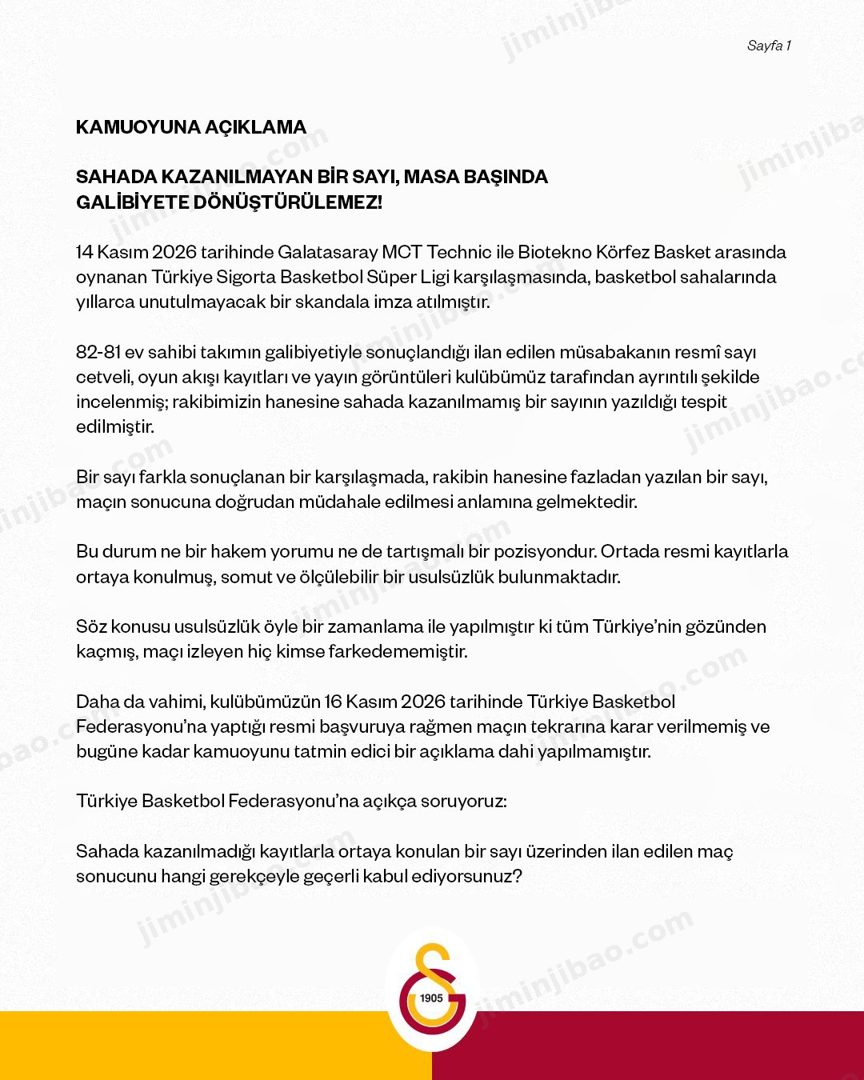
Their words, translated: in a game decided by one point, an extra point written to the opponent means the result itself was changed. “This is neither a referee's judgement nor a disputed call.”
The dunk that counted three
Turkish fans then found the moment. Third quarter, Körfez leading 53-37, 7:33 on the clock. Körfez's Johnny Davis finishes the play with a dunk, right under the basket. The TV pictures are clear: a dunk, two points.
The official play-by-play says something else: “#1 Johnny Davis, 3-point jump shot, made. 56-37.” Two points on the court. Three on the sheet.
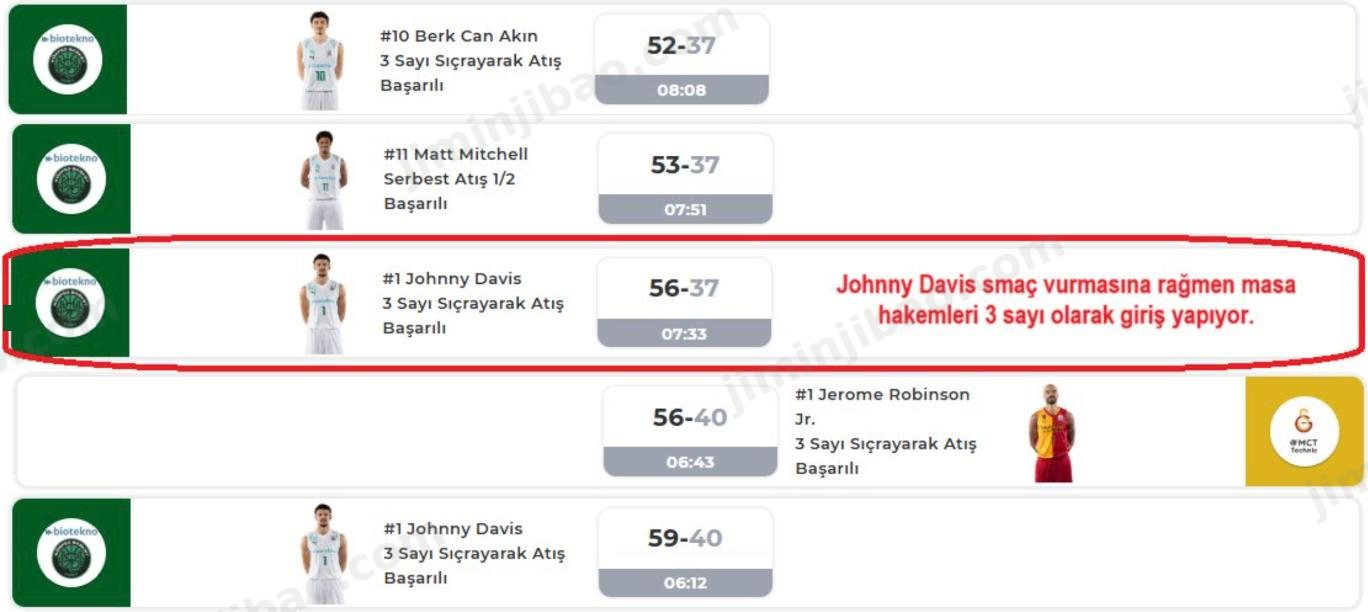
The TV scoreboard got it right at first. After the dunk it showed 55-37. Two points, like on the court. For almost two minutes the TV board and the official sheet showed different scores.
Then, at 5:52 of the third quarter, Körfez are bringing the ball up. Nobody has shot. Nobody is at the free-throw line. And the scoreboard goes from 58 to 59. One point, out of nowhere, in the middle of a possession. The board was “fixed” to match the sheet, not the other way round.
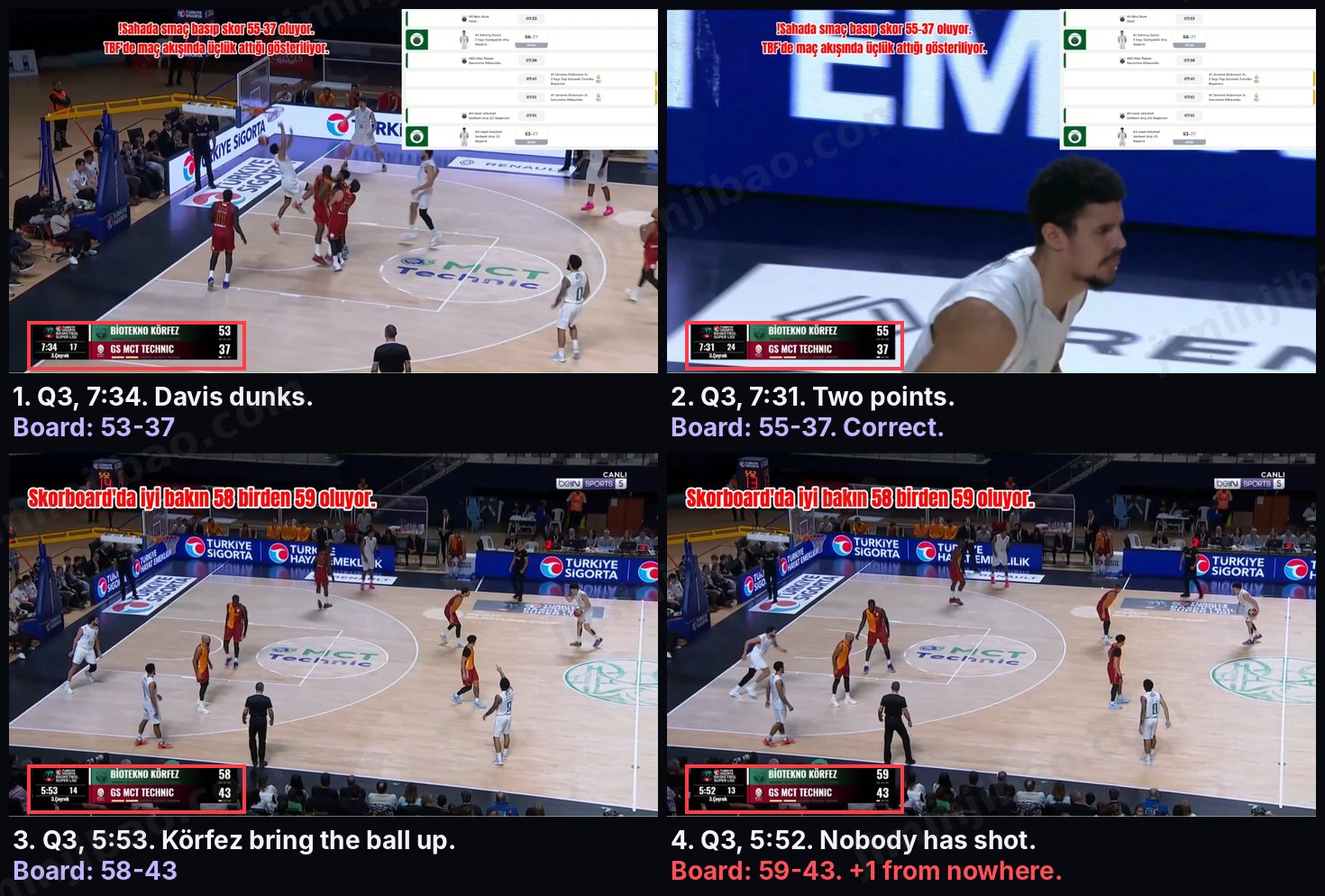
Nobody fixed it after that, and it rode along for the rest of the game. At the final buzzer the board said 82-81. On the court, it was 81-81.
The federation hasn't said this is wrong. It just hasn't done anything.
Nobody saw it
This is the part I find most interesting. Galatasaray say the timing was such that “all of Turkey missed it” and nobody watching the game noticed. A dunk in the middle of the third quarter, with Körfez 16 points up. Who checks the scoresheet then? Not the players. Not the coaches. Not the three referees, the table officials or the stats crew. Not the TV commentators.
Galatasaray went to the Turkish Basketball Federation on 16 November and asked for the game to be replayed. The federation said no replay. Galatasaray now quote the league's own rule, article 54.2, which says the federation can step in directly even when nobody protested in time. They say they will go to court.
The basketball site Basketfaul pointed out the problem with that. Under the rules, a team that wants to protest a result has to tell the referee within 15 minutes of the end, with the captain signing the scoresheet, and give the reasons in writing within an hour. Galatasaray's staff didn't see it in time. So the table may have made the mistake, and the result still stands.
If it can take a professional club a week of going through video to find one point, what chance do you have from your phone?
What it did to your bet
Bets are settled on the official result. Not on what happened. On what's written down.
The score on the court was 81-81 at the buzzer. That's overtime, and nobody knows who wins it. But here is how it was settled:
- Galatasaray to win: lost. Maybe they'd have won it in overtime. You'll never know.
- Galatasaray +0.5: lost by half a point. A 81-81 regulation finish would have won it.
- Over 162.5 total points: won with 163. Under 162.5 lost by one point that was never scored.
- Odd or even total: 163 is odd. 162 is even.
- Any bet that counts overtime: settled on a game that ended without the overtime it may have needed.
And here's the part beginners don't know. Most bookies' rules say they settle on the result at the end of the game, and that later changes, protests and appeals don't count for betting. So even if the federation replayed this game tomorrow, every bet on the first one stays exactly as it was settled. Lost is lost.
You did nothing wrong. Your read on the game might have been perfect. A scorer wrote one point in the wrong column and your money went with it.
All the ways a bet can lose
Most people think a bet loses because they picked the wrong side. That's only one way. Here are the others, and every one of them has happened to real money, a lot of it mine.
1. The table writes it down wrong
This story. The score that counts is the one on the sheet.
2. The stats are wrong
Player props are settled on official stats, and official stats are typed in live by people. I've seen a league valued at $100 million put the wrong fouls on its own box score, and a major European league's live stats lose two players for a whole game: 42 points scored by nobody. If your bet was on one of those players, the sheet decided it, not the game.
3. The referee
A bad call in the last minute, a foul not given, a goal that wasn't. Refs are human and the result stands. I talked about this in why even the best bet can lose.
4. The last second
This game was lost on a basket in the last second. Grambling State were up 4 with 0.9 seconds left and lost in double overtime. Your bet is only as good as the worst second of the game.
5. Something that happens once in 20,000 games
A player lays the ball into her own basket on purpose. It happens about once in 20,000 games. One day it happened twice.
6. The game wasn't real
Some games are fixed. You can't see that from the odds or the stats. A member of my team called Botafogo v Rio Claro fishy while it was live. Months later came the FIBA bans.
7. One leg of the combo
Every extra leg is one more of all these chances to lose. The “safe” favourite is very often the leg that kills the slip.
8. You win, and the bookie takes it back
Even when everything goes right on the court, the bookie can still lose it for you. bet365 repriced 161 winning bets the morning after a game. BetBTC voided my winners. DraftKings tried to cancel a $934,147 win. bet365 took back a cash out.
9. You were right, and still lost
And when nothing at all goes wrong, a good bet still loses a lot of the time. That's what a price is. Being right over hundreds of bets is the only thing that counts, and the losing streaks on the way there are longer than you think.
Look at that list again. You control the first decision, which bet. Almost nothing after it.
The facts here come from Galatasaray's public statement of 23 November 2026, the beIN Sports Türkiye match report of 14 November 2026, and Basketfaul's report on the statement. The 7:33 dunk logged as a three and the 58-to-59 jump at 5:52 come from the official play-by-play and the beIN Sports broadcast, as shared by Turkish fans on X on 23 November. The federation has not ruled on it publicly. If the Turkish Basketball Federation, Körfez or Galatasaray want to add anything, the free right of reply applies: [email protected].
Before your first bet
- Your bet is settled on what's written down, not on what happened.
- Later corrections, protests and replays almost never change a bet that's already settled.
- Count how many things outside your pick can lose it: the table, the stats, the ref, the last second, a fix, the bookie.
- Every leg you add to a combo adds all of them again.
- Even a perfect read loses often. That's not bad luck. That's betting.
Or skip all of it.
Don't even start.