
Home / War on bookies / Stories
It voided the winners. It couldn't show it voided the losers. A judge: pay R$208,000.
A bettor in Brazil won on a darts match. The bookie, Aposta Ganha, cancelled his winning tickets after the match, gave him back his stakes and blamed a “technical problem at the provider”. A judge in Caruaru, Pernambuco, said no: a pricing mistake is the bookie's own business risk, not the customer's. Pay the full winnings, R$208,000, about US$41,000, plus interest and 15% legal fees.
The short version
- He won. They cancelled it after the match. Darts, Modus Super Series, total legs over 4.5. Stakes back, winnings gone. The bet
- Their excuse: the odds provider made a mistake. The judge: the bookie opened the market, set the price and took the money. Its mistake, its risk. The ruling
- The “we can cancel after the event” rule in their terms: void. No sign of fraud or bad faith by the bettor. The ruling
- The killer: they never proved they cancelled the losing bets too. Cancel only the winners and you're not fixing an error. Only the winners
- Winning in court isn't getting paid. Brazil banned online betting in September 2026 and revoked the licences, so the bookie has no licence left to protect. Will he see it?
The bet
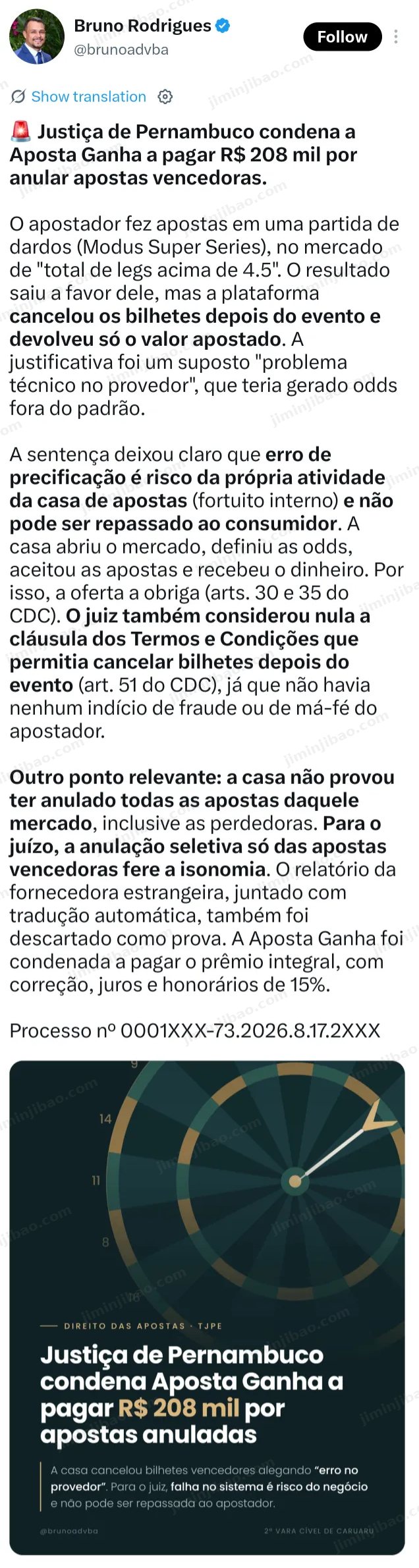
A bettor placed bets with Aposta Ganha, one of Brazil's licensed bookies, on a darts match in the Modus Super Series. The market: total legs over 4.5. The match went his way. Over 4.5. Winner.
Then Aposta Ganha cancelled the tickets. After the match, after the result was known. It gave him back what he had staked and kept the winnings. The reason it gave: a supposed “technical problem at the provider”, the outside company that supplies its odds, which had produced prices “out of the normal pattern”.
He went to court. On 25 November 2026 the Brazilian lawyer Bruno Rodrigues, who writes about betting law, published the ruling's main points.
What the judge said
Three things, and every bettor should know all three.
One: a pricing mistake is the bookie's problem. The bookie opened the market, set the odds, accepted the bets and took the money. Under Brazil's consumer code that offer binds it. A mistake inside its own operation, its own systems or its own supplier, is the risk of the business it chose to run. It can't be handed to the customer after the result is in.
Two: the small print doesn't save it. Aposta Ganha's terms let it cancel tickets after the event. The judge declared that clause void as abusive under the consumer code, because there was no sign of fraud or bad faith by the bettor. He just bet at the price he was offered.
Three: its evidence didn't count. The bookie brought a report from its foreign odds supplier, translated with a machine translator. The court threw it out.
That's the same thing the Massachusetts regulator told DraftKings: its own error, the cost of doing business, pay every cent. Different country, different sport, same answer.
Only the winners
And then the point I like most. The judge noted that Aposta Ganha never proved it had cancelled all the bets on that market. Including the losing ones.
Think about what that means. If the price was really wrong, every bet at that price was wrong. The people who bet the other way and lost were betting on the same broken market. A bookie that's really fixing a mistake cancels the whole market and gives everybody their money back.
A bookie that cancels only the tickets that won isn't fixing a mistake. It's keeping the losers' money and refusing to pay the winners. The court called it what it is in law: selective cancellation of the winners breaks equal treatment.
I've lived this. bet365 repriced 161 winning bets the morning after a game. BetBTC voided my winners. Every time, the “error” is only found on the tickets that won. You never get an email saying a losing bet was settled at a bad price, so here's your stake back.
Will he ever see it?
Here's the twist. Aposta Ganha is a Brazilian company, and until recently it had a federal betting licence from the Ministry of Finance. It's also been the master sponsor of the São João festival in Caruaru, five years running. The court that ruled against it sits in the same city.
But in September 2026 Brazil banned online betting again. Medida Provisória 1.394 revoked the licences, stopped new bets immediately and ordered the platforms to close and give customers back their balances. Congress extended it on 11 November. The Supreme Court is looking at challenges to it.
So the logic that made DraftKings pay doesn't work here. DraftKings paid because losing the licence would cost it far more. Aposta Ganha's Brazilian licence is already gone. There's nothing left to protect with a US$41,000 cheque.
What's left is a Brazilian company with an address in Brazil, which a Brazilian court can go after. R$208,000 is about US$41,000, small money for a company that paid to put its name on one of Brazil's biggest festivals. My guess is it pays. But this is a first-instance ruling, it can still be appealed, and a bookie that's closing down has every reason to drag it out. Winning in court and getting paid are two different things. Nobody can promise him the second one.
Most bettors in the world don't have either. In Brazil itself, a 1win winner only got paid after his post hit 893,000 views. And a bettor in Argentina is still waiting after his bookie told everyone on X the payout was “corrected”.
The facts here come from lawyer Bruno Rodrigues' summary of the ruling of the 2nd Civil Court of Caruaru (TJPE), published on X on 25 November 2026, with the case number partly hidden. I haven't read the full ruling. The sponsorship is from Yogonet (February 2026), the betting ban from Agência Brasil (11 November 2026); the dollar figure uses about R$5 to the dollar. If Aposta Ganha wants to answer, or has appealed, the free right of reply applies: [email protected].
Before your first bet
- If a bookie cancels your winner as an “error”, ask it one question: did you cancel the losing bets on that market too?
- “Technical problem at the provider” is the bookie's problem. In Brazil a court has now said so.
- Screenshot your tickets, the price and the market before the event. That's your evidence.
- A court can order a bookie to pay. Getting the money is another fight, and harder once the bookie has nothing left to lose.
- US$41,000 is less than a festival banner to them. Your winnings are never a big deal to the bookie, only to you.
Or skip all of it.
Don't even start.